Preference survival

Memory forgets preferences evenly, but serves only the default user

When memory forgets a preference, the model falls back on its usual answer, its default. Early results from a development study.

01 Homogenization

Language models make answers, writing and outcomes more alike

Across models

Different models give strikingly similar answers.

Jiang et al., NeurIPS 2025
Across writers

Essays written with InstructGPT are more alike.

Padmakumar and He, ICLR 2024
Across systems

Systems that share data fail the same people.

Bommasani et al., NeurIPS 2022
02 The problem

Some users want what the model assumes, and some do not

prose or bullets
diagrams or text
alone or group
quiet or lively
matches all 4
1 of 4 differ
2 of 4 differ
2 of 4 differ
3 of 4 differ
4 of 4 differ

Six of 36 users from the development study. Red: not what models assume.

02 The problem

A forgotten preference becomes the model's usual answer

The user says
Memory, session 12
The answer
User A
“Please write in paragraphs, not bullet points.”
nothing about format
bullet points, wrong
User B
“Bullet points, please.”
nothing about format
bullet points, right

Made-up example. The model's usual choice is its default. It is right only for User B.

03 How it happens

Three steps turn even forgetting into uneven outcomes

  1. 1A writer model rewrites memory and drops preferences evenly.
  2. 2A reader model fills each gap with its default.
  3. 3Models from different labs share the same defaults.

Shared defaults so far: plain wording, brief answers, bullet lists, a serious tone.

04 Early result

Users who differ from the default fall to a coin flip

Guess first

After 12 sessions, how often is a preference against the default answered correctly?

93%matches the default
50%against the default
100%either kind, from the full chat history

Development study, 2026-10-08: 36 synthetic users, two reader models.

04 Early result

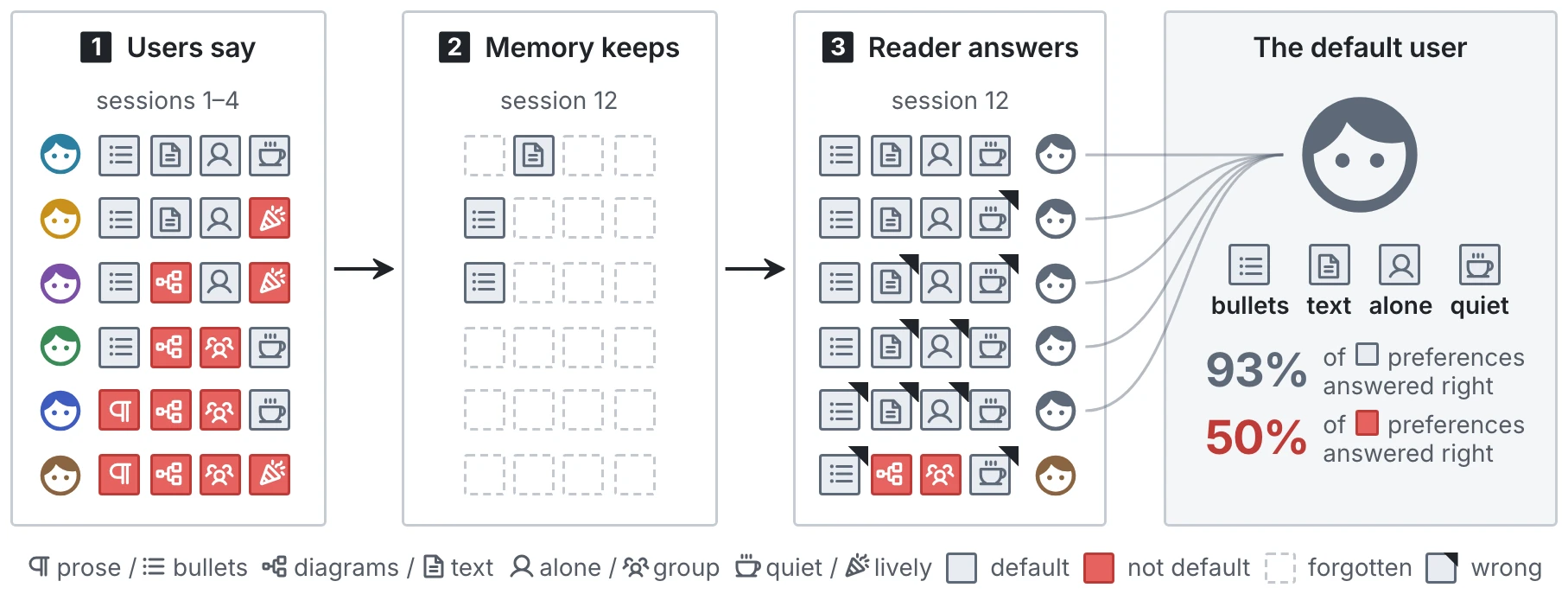
Five of six example users end up answered as the default user

Six users state preferences in sessions 1 to 4; red marks a preference that differs from the model's default. By session 12 memory keeps only three of 24 preferences. The reader answers the rest with its default, so five of the six users get the same answers as one default user: bullets, text, alone, quiet. Pooled over all 12 memory systems, 93% of preferences that match the default are answered right, and 50% of those that differ.

Demo from the development study: six of 36 users, GLM writer, DeepSeek reader. Percentages pool all 12 memory systems.

05 Where the bias comes from

Writers forget both sides equally; the reader adds the bias

A preference is still in memory
when stated
96%
1 rewrite later
77%
4 rewrites later
54%
10 or 11 later
37 to 47%
4 pointsat most between what writers keep on each side of the default
87%of the preferences memory dropped were answered with the default

Development study, three writer families. The 87% is one reader at session 12.

06 Shared failures

Switching memory systems does not help users who differ

100%

of the preferences that nearly every memory setup got wrong belonged to users who differ from the default.

Wrong in at least 10 of 12 setups: 3 writer models times 4 memory formats. The reason is that all setups drop the same kinds of preferences.

07 What this does not show yet

The early results are small, synthetic and judged by a model

  • 36 made-up users and three model families.
  • Labels come from a model judge, not from people.
  • Random forgetting explains most of the effect; memory adds 2 to 5 points.
  • Writers go over the length limit, so equal-length comparisons are rough.
08 Related work

Prior work finds homogenization, but not memory drifting to defaults

arXiv 2026

PRISK

Wang et al., 2026

Personal memories make models more sycophantic.

DifferenceThey use memory once. We rewrite it 12 times.
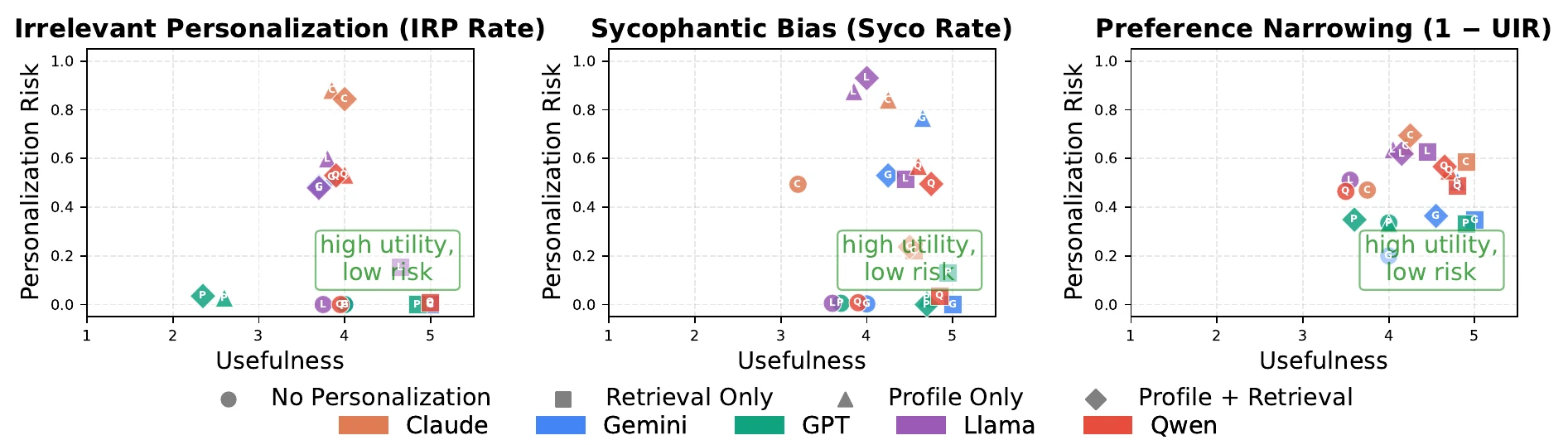
Figure 4 of Wang et al.: personalization risk against usefulness for Claude, Gemini, GPT, Llama and Qwen on irrelevant personalization, sycophantic bias and preference narrowing; points with a profile, retrieval, or both sit higher in risk than the no-personalization points.
Main result

Across 13 LLMs, user profiles and retrieved memories made all three biases worse: irrelevant personalization, preference narrowing and sycophancy.

Wang et al., arXiv 2608.28833, abstract and Figure 4.
arXiv 2026

Personalize-then-Store

In et al., 2026

Memory should learn what each user needs stored.

DifferenceThey skip passing chats. We skip what models guess.

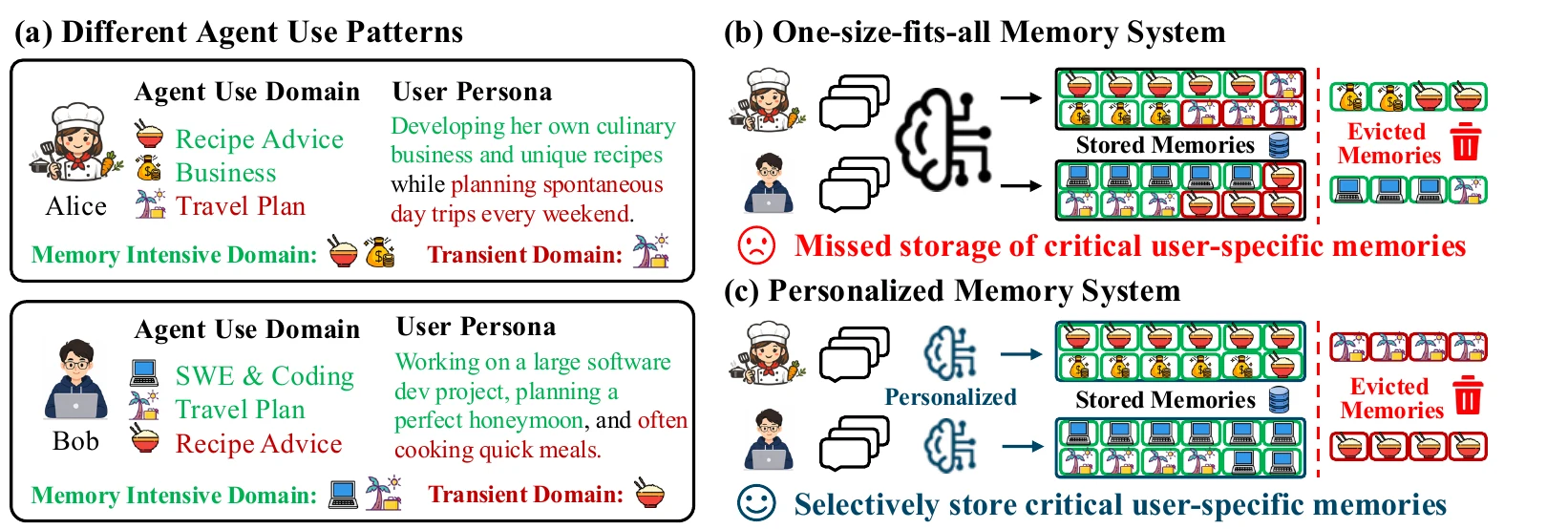
Figure 1 of In et al.: Alice and Bob use an agent for different domains; a one-size-fits-all memory system evicts memories each of them needs, while a personalized memory system keeps each user's important memories and evicts their transient ones.
Main result

Storing per user helps retention a lot when the system knows which sessions to skip. Knowing which to skip is still unsolved.

In et al., arXiv 2605.25535, abstract and Figure 1.
NeurIPS 2022

Picking on the Same Person

Bommasani et al., 2022

Shared parts make systems fail the same people.

DifferenceThey test fairness data. We test assistant memory.

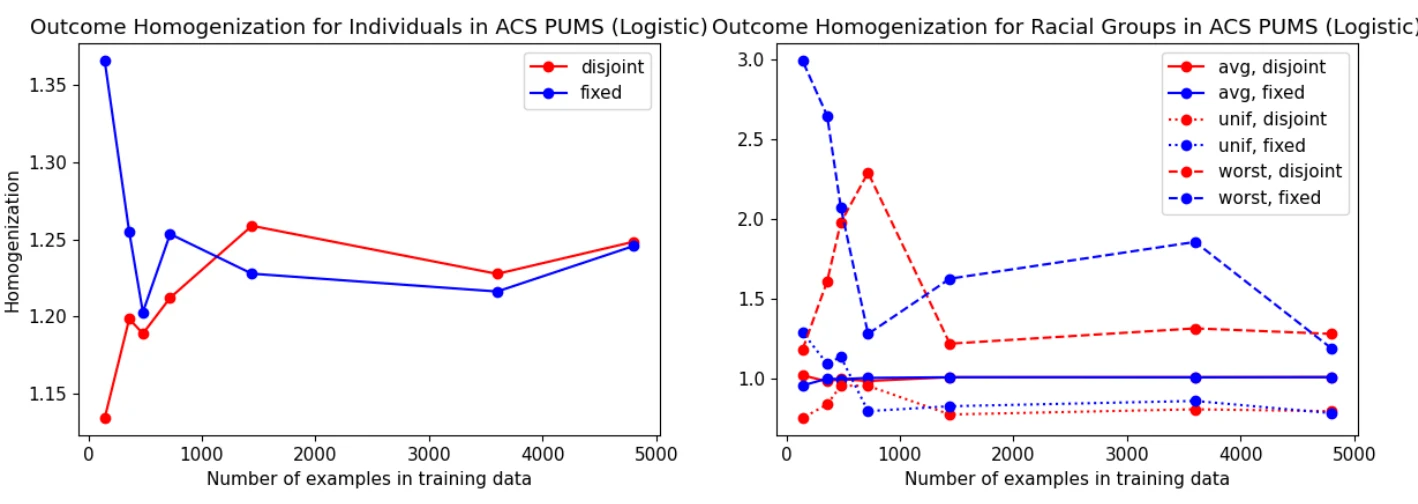
Figure 2 of Bommasani et al.: outcome homogenization on ACS PUMS with logistic regression as training data grows, for models trained on fixed (shared) versus disjoint data, at the individual level (left) and for racial groups (right).
Main result

Sharing training data reliably made outcomes more alike, and more so for individuals than for groups.

Bommasani et al., arXiv 2211.13972, abstract and Figure 2.
Preference survival

Thank you

Questions?