Scoring Targets Change Which Memory System Wins

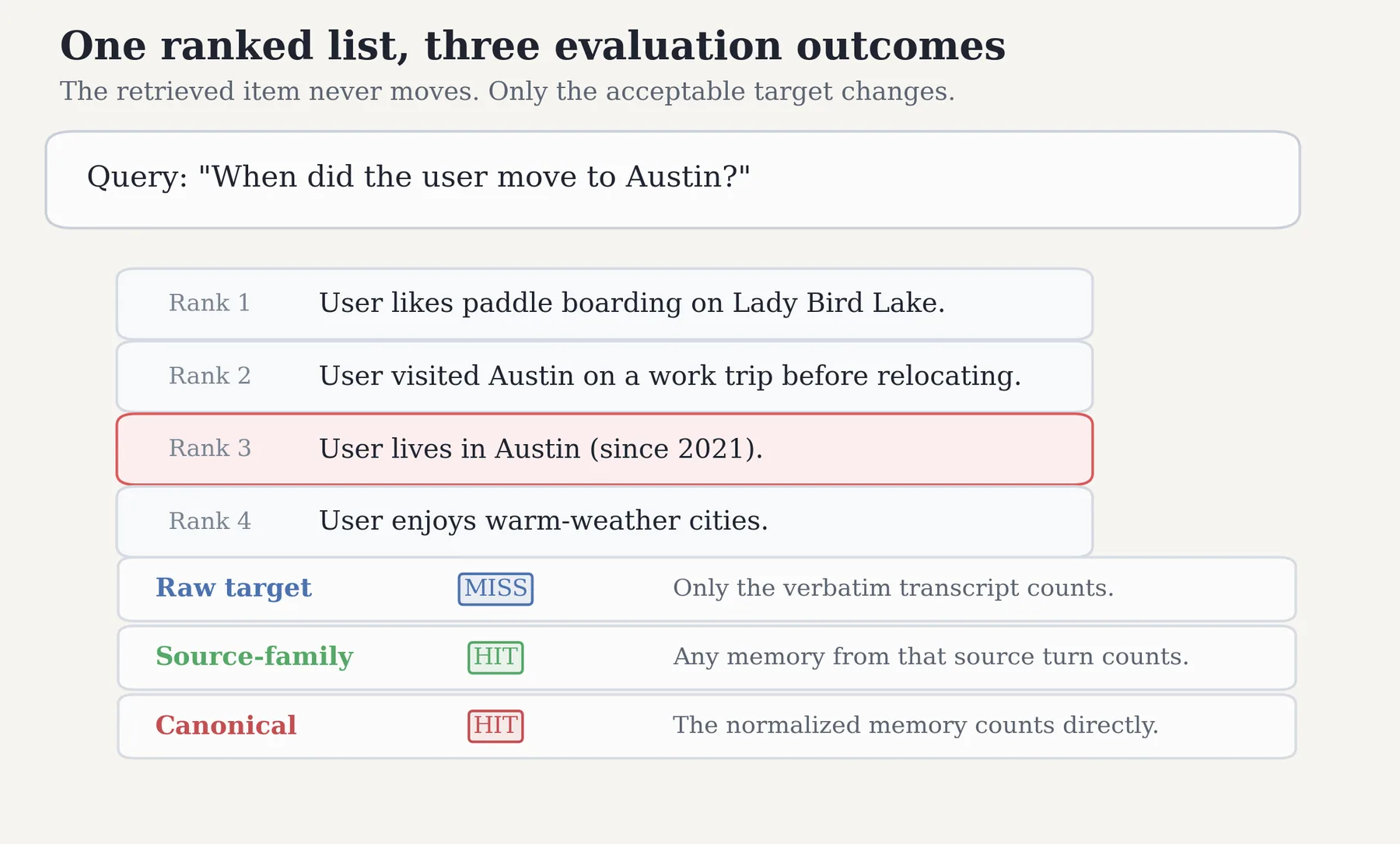
You run a memory system on a standard benchmark. It retrieves a transformed memory stating that the user moved to Austin in summer 2021, but the benchmark scores a miss because it accepts only the original transcript turn.
Rescoring the same ranked list against the transformed memory produces a hit. No retrieved item moved. The scoring target alone changed the result. This is a systematic failure mode in evaluations of transformed conversational memory.

One answer can appear in three stored forms
Modern memory systems transform raw dialogue turns. The same evidence can live in the store as:
- The original turn:
"Yeah I actually just relocated to Austin last summer, it's been great so far." - A derived observation:
"User relocated to Austin in summer 2021." - A canonical fact:
"User lives in Austin (since 2021)."
Now ask the benchmark: "When did the user move to Austin?"
If the retriever surfaces the canonical fact at rank 3, that is obviously useful evidence. But if the benchmark only grants credit to the raw transcript turn ID, it records a miss anyway.
I call this target non-invariance: benchmark conclusions that flip even when the ranked output is held fixed, purely because the evaluation target definition changes.
Rescoring changes most query-level nDCG values
I rescored fixed ranked outputs from two benchmarks, LoCoMo and LongMemEval-S, across four retrievers:
- Lexical search
all-MiniLM-L6-v2BGE-M3mxbai-embed-large
Each run was scored under three target definitions:
- Raw: only verbatim transcript turns get credit
- Source family: anything derived from the same source turn gets credit
- Canonical: only transformed, non-raw memories get credit
The ranked lists never changed. Only the scoring target did.
Switching the target changes nDCG on 83% to 93% of shared queries
On shared queries where both raw and canonical targets apply, switching only the scoring target changed per-query nDCG on 83.4% to 93.1% of queries across the two benchmarks.
The evaluation changes because its target definition contains an unreported assumption about which representation deserves credit.
Canonical beats Raw everywhere, with margins from 0.068 to 0.420
On the canonical-covered shared subset, Canonical beats Raw on every native run. But the size of the gap changes dramatically:
- LoCoMo + BGE-M3:
+0.068nDCG - LongMemEval-S + mxbai-embed-large:
+0.420nDCG
That is roughly a six-fold swing in the apparent quality gap between the same two target choices.
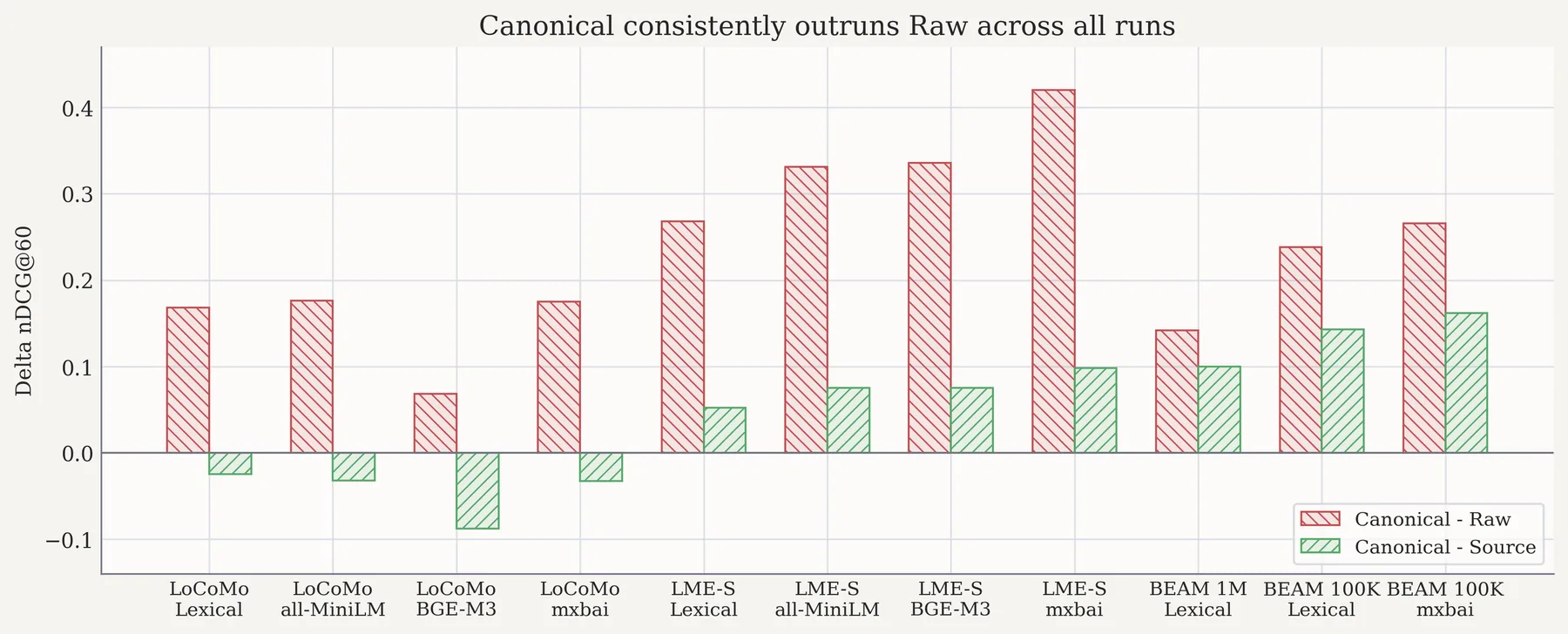
Fixed-subset rescoring on the canonical-covered shared subset
| Dataset | Provider | n | Raw | Source | Canonical | Canonical - Raw | Canonical - Source |
|---|---|---|---|---|---|---|---|
| LoCoMo | Lexical | 899 | 0.1876 | 0.3809 | 0.3556 | +0.168 | -0.025 |
| LoCoMo | all-MiniLM | 899 | 0.2118 | 0.4198 | 0.3875 | +0.176 | -0.032 |
| LoCoMo | BGE-M3 | 963 | 0.2548 | 0.4109 | 0.3231 | +0.068 | -0.088 |
| LoCoMo | mxbai-embed-large | 899 | 0.2120 | 0.4195 | 0.3870 | +0.175 | -0.033 |
| LongMemEval-S | Lexical | 332 | 0.1877 | 0.4041 | 0.4558 | +0.268 | +0.052 |
| LongMemEval-S | all-MiniLM | 332 | 0.2001 | 0.4561 | 0.5309 | +0.331 | +0.075 |
| LongMemEval-S | BGE-M3 | 299 | 0.1969 | 0.4576 | 0.5326 | +0.336 | +0.075 |
| LongMemEval-S | mxbai-embed-large | 332 | 0.1815 | 0.5032 | 0.6015 | +0.420 | +0.098 |
Every score in the table comes from the same saved traces. Only the credited target changes.
Target choice changes the preferred memory-store density
I ran a parser-density sweep where:
F1extracts 1 transformed fact per source turnF5extracts 5 transformed facts per source turnF8extracts 8 transformed facts per source turn
On a fixed shared subset of 453 queries, the preferred configuration flips depending on the target definition.
In the lexical F1 vs F5 comparison:
- Raw prefers the sparser
F1 - Source family prefers the denser
F5 - Canonical goes back to
F1
Across all six pairwise comparisons in the retained fixed-subset sweep:
- Source family prefers the denser store in all 6 of 6 comparisons
- Raw prefers the sparser store in 4 of 6 comparisons
- Canonical splits, with
F1winning 4 of 6 andF8winning bothF5 vs F8comparisons
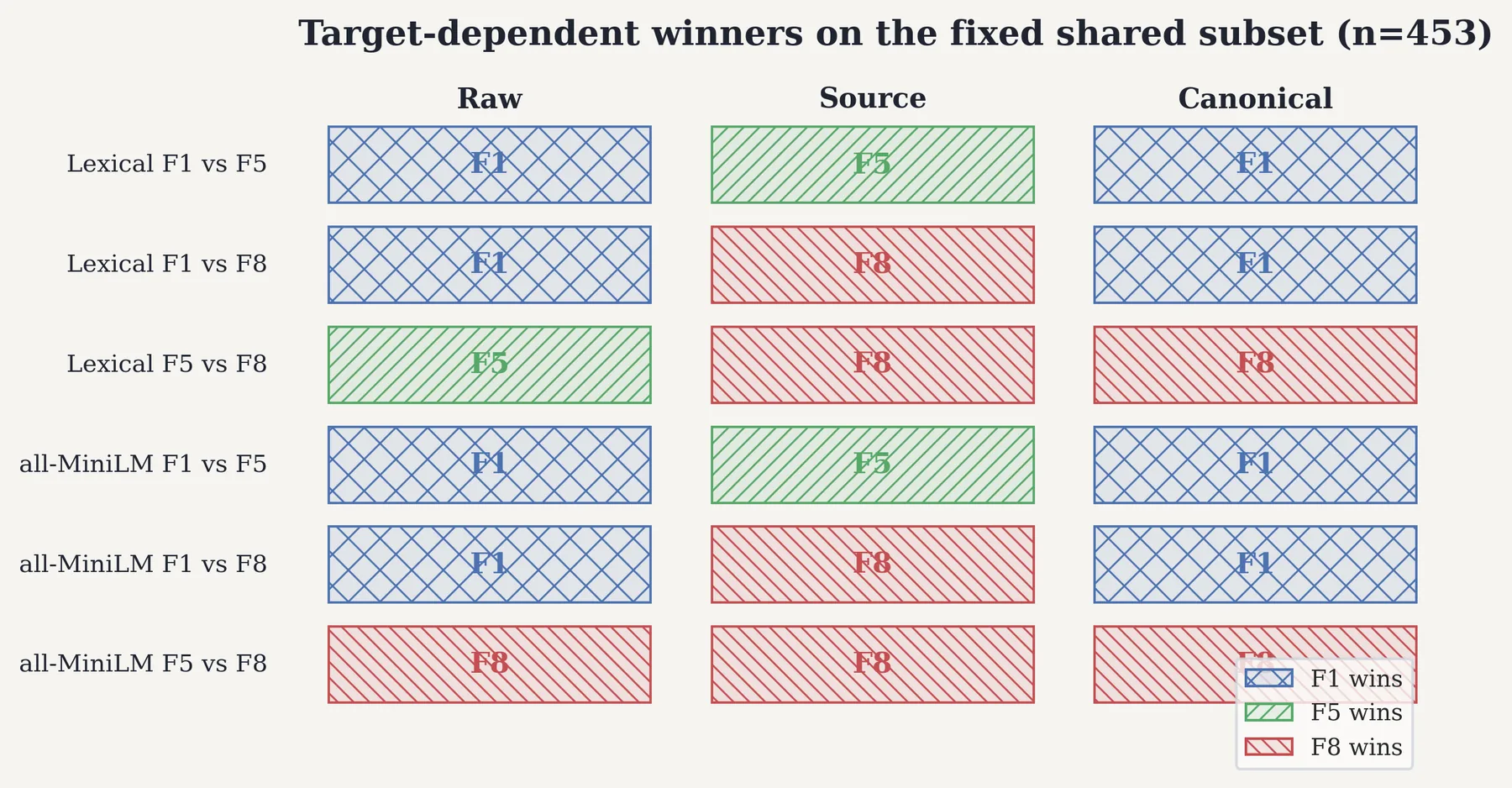
Target-dependent winner table on the fixed shared subset (n = 453)
| Provider | Comparison | Raw | Source | Canonical |
|---|---|---|---|---|
| Lexical | F1 vs F5 | F1 | F5 | F1 |
| Lexical | F1 vs F8 | F1 | F8 | F1 |
| Lexical | F5 vs F8 | F5 | F8 | F8 |
| all-MiniLM | F1 vs F5 | F1 | F5 | F1 |
| all-MiniLM | F1 vs F8 | F1 | F8 | F1 |
| all-MiniLM | F5 vs F8 | F8 | F8 | F8 |
The benchmark family, underlying evidence, and 453-query subset are fixed. Changing the target changes the winner.
Mem0 and MemoryOS show different target orderings
I also rescored full runs from two external memory architectures, Mem0 and MemoryOS, on full LoCoMo and LongMemEval-S runs.
The non-invariance survives across both. But the ordering is not uniform:
- Mem0 / LoCoMo: Source > Canonical > Raw
- Mem0 / LongMemEval-S: Source > Raw > Canonical
- MemoryOS / LoCoMo: Source > Raw > Canonical
- MemoryOS / LongMemEval-S: Source > Canonical > Raw
For Mem0 on LongMemEval-S, the stakes are especially clear:
- Source gains
+0.150nDCG over Raw - Canonical falls
-0.131below Raw - Raw-vs-canonical scoring changes MRR on
466 / 470queries
The recent BEAM runs preserve the same story:
- BEAM 1M lexical:
Raw 0.055,Source 0.097,Canonical 0.197 - BEAM 100K lexical:
Raw 0.110,Source 0.206,Canonical 0.349 - BEAM 100K mxbai:
Raw 0.123,Source 0.228,Canonical 0.390
Those absolute scores are lower than LoCoMo and LongMemEval-S, but that does not weaken the claim. In the current harness, BEAM is harsher: it uses much longer turn-sized retrieval rows, and many questions ground to multiple source turns, so it behaves more like an aggregation-heavy long-context stress test.
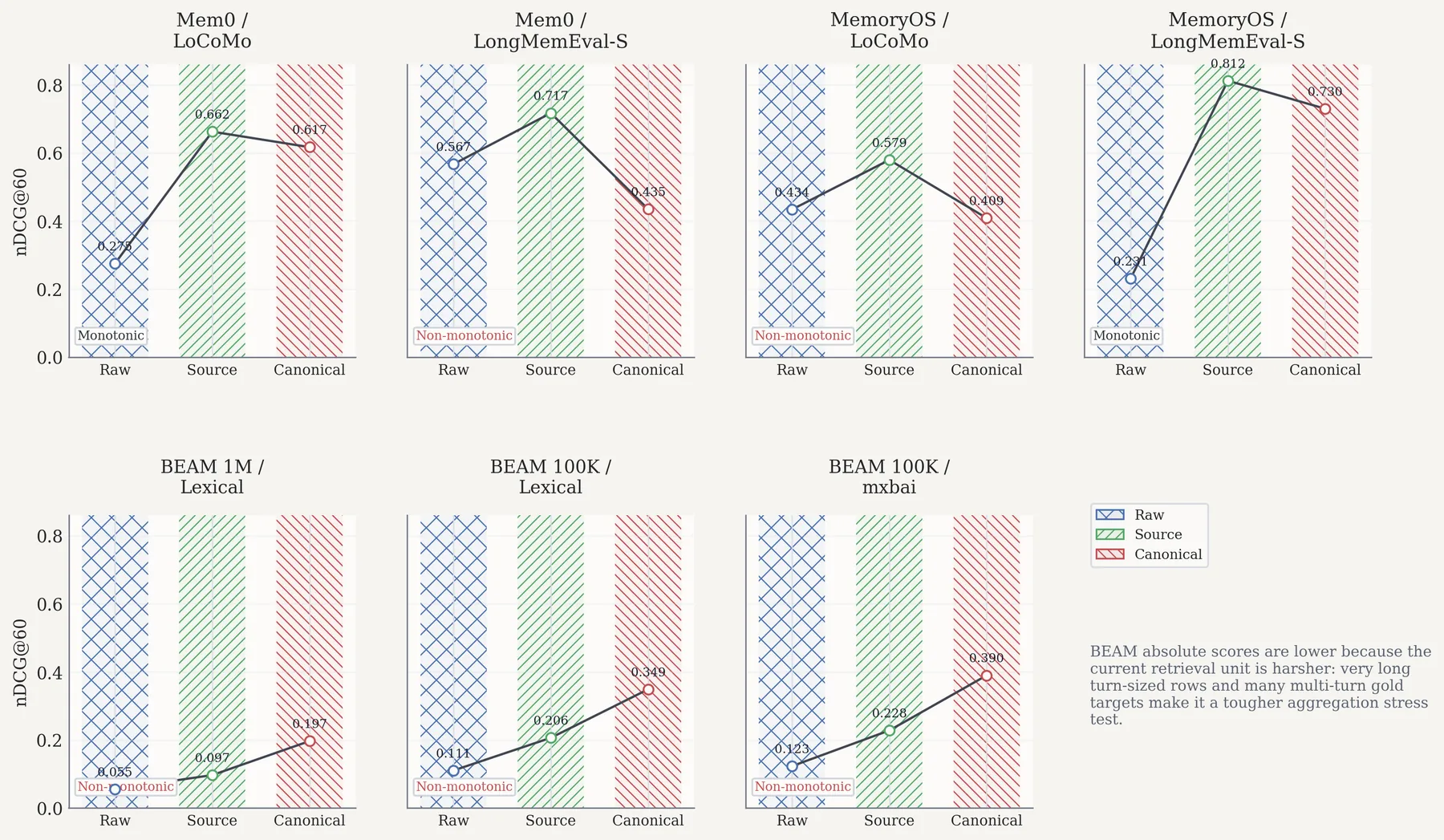
Architectural transfer summary, full-run nDCG@60
| System / Dataset | Raw | Source | Canonical |
|---|---|---|---|
| Mem0 / LoCoMo | 0.2749 | 0.6625 | 0.6169 |
| Mem0 / LongMemEval-S | 0.5670 | 0.7170 | 0.4350 |
| MemoryOS / LoCoMo | 0.4339 | 0.5794 | 0.4086 |
| MemoryOS / LongMemEval-S | 0.2306 | 0.8121 | 0.7298 |
The transfer runs do not support a general claim that more abstract targets score higher. They show that the target definition changes the reported ordering.
Human review rejects some relaxed-target credit
Maybe a permissive target is just inflating scores by awarding credit to memories that do not really answer the query. So I audited 120 disagreement cases where raw-turn scoring gave no credit but source-family and canonical scoring did.
The results were mixed:
28 / 120fully support the query49 / 120are partially supportive43 / 120do not support it
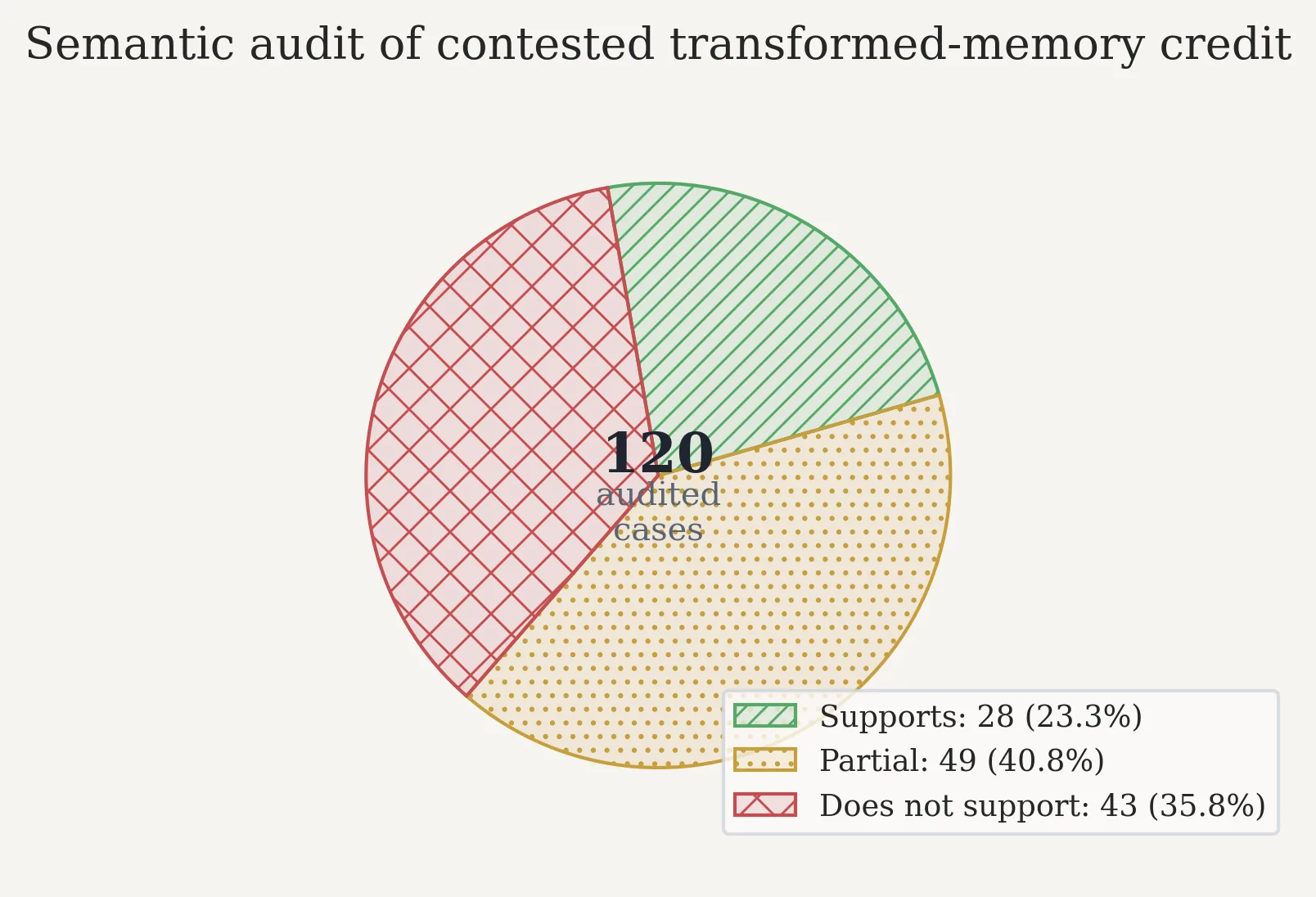
Completed 120-query semantic audit
| Dataset | Supports | Partial | Does not support |
|---|---|---|---|
| LongMemEval-S | 9 | 25 | 26 |
| LoCoMo | 19 | 24 | 17 |
| Total | 28 | 49 | 43 |
Among the non-supportive cases, the dominant failure modes were:
- Missing a required detail such as a date, count, or named entity:
28 / 43 - Retrieving generic background context instead of answer-bearing evidence:
8 / 43 - Retrieving the wrong event or timeline entirely:
7 / 43
That 36% non-support rate applies to the contested disagreement pool, not to all canonical-credit queries. In the two audited runs, that disagreement pool was about 19.9% of canonical-hit queries, which projects to roughly 7.1% of all canonical-hit queries.
The audit finds genuine false credit, but that false credit does not make raw-only scoring a valid default for systems that serve transformed memories.
Raw, Source family, and Canonical answer different questions
These targets are not interchangeable. They answer different evaluation questions.
| Target | What it credits | What it is really asking |
|---|---|---|
| Raw turn | Verbatim source-turn memories only | Did we retrieve the exact utterance history? |
| Source family | Any memory derived from the same source turn | Did we retrieve the right underlying event, regardless of representation? |
| Canonical | Transformed non-raw memories derived from the source turn | Did we retrieve the normalized memory layer intended for serving? |
By construction:
Raw ⊆ Source familyCanonical ⊆ Source familyRawandCanonicalare usually disjoint
That makes Source family a provenance-relaxed upper bound, Raw a strict floor, and Canonical the deployment-aligned target when the product actually serves transformed memory rather than transcript snippets.
Report multiple targets and inspect winner flips
If you are building or benchmarking transformed conversational memory, the reporting policy should change.
- Use Canonical as the primary reported target when the deployed system serves transformed memories or normalized facts.
- Always report Raw alongside it as a floor, especially if your product surfaces transcript snippets or exact provenance matters.
- Use Source family as a stress test, not as a safe standalone leaderboard target.
- Run shared-subset rescoring whenever ontology coverage differs across systems or configurations.
- Inspect query-level disagreement before pretending target choice is innocuous. In these runs, raw-vs-canonical switching changed nDCG on 83% to 93% of shared queries.
- Flag winner flips. If one target recommends a different system or store density, that disagreement is a result, not an annoyance to smooth away.
A benchmark score includes an ontology choice
If your memory benchmark can score the same ranked list as both a miss and a hit, depending only on which stored representation it is willing to count as correct, then the benchmark is not measuring a stable property of retrieval quality.
It measures retrieval quality together with an ontology choice about which stored forms count as relevant. Report that choice explicitly.
This post is the public companion to our paper, Same Ranking, Different Winner: How Scoring Targets Shape LLM Memory Benchmarks, by Sugam Panthi and Rabab Abdelfattah, accepted to Findings of EMNLP 2026.
@inproceedings{panthi2026memorytargets,
  title         = {Same Ranking, Different Winner: How Scoring Targets Shape {LLM} Memory Benchmarks},
  author        = {Panthi, Sugam and Abdelfattah, Rabab},
  booktitle     = {Findings of the Association for Computational Linguistics: EMNLP 2026},
  year          = {2026},
  note          = {To appear},
  eprint        = {2605.24060},
  archivePrefix = {arXiv},
  primaryClass  = {cs.CL},
  doi           = {10.48550/arXiv.2605.24060},
  url           = {https://arxiv.org/abs/2605.24060}
}